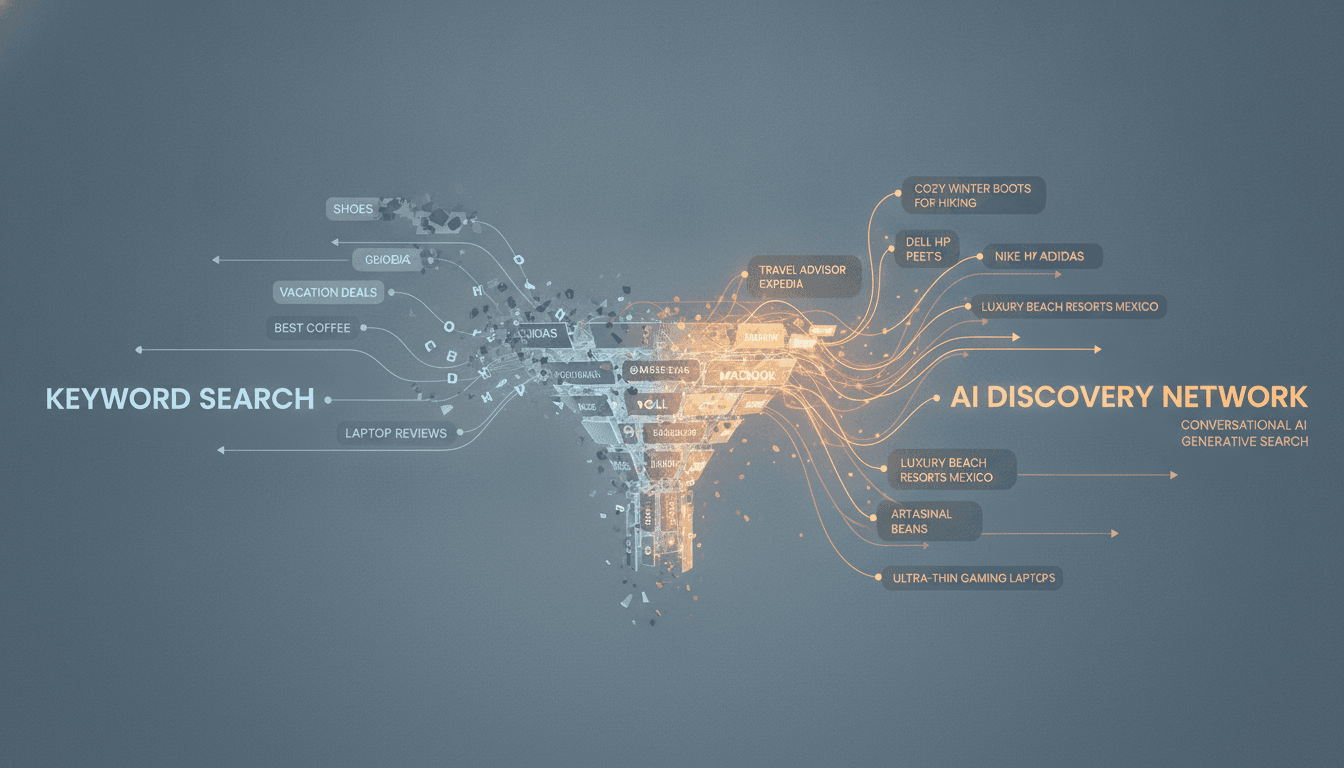
AI Search Privacy and Ethics: A Guide for Brands Navigating the New Marketing Landscape
As AI search and shopping tools reshape consumer behavior, brands face urgent questions about privacy, transparency, and ethical responsibility. This guide empowers marketing leaders to navigate the new AI-driven landscape while safeguarding trust, equity, and compliance.

AI Search Privacy and Ethics: A Guide for Brands Navigating the New Marketing Landscape
As AI search and shopping tools revolutionize consumer behavior, brands confront urgent questions about privacy, transparency, and ethical responsibility. This guide equips marketing leaders to navigate the evolving AI-driven landscape while safeguarding trust, equity, and compliance.
[IMG: AI-powered shopping assistant interacting with a consumer on a digital device]
The rise of AI-driven search and shopping tools is transforming how consumers discover and select products, presenting brands with unprecedented challenges around privacy and ethics. With 78% of consumers expressing concern about how their personal data is used and 61% of marketing executives worried about AI bias affecting brand visibility, grasping the ethical landscape is no longer optional—it’s imperative. This guide unpacks what brands must consider to deploy AI marketing responsibly while cultivating lasting consumer trust.
Ready to align your brand with ethical AI marketing and protect consumer privacy? Schedule a personalized 30-minute strategy session with Hexagon’s experts today.
Understanding the Ethics of AI Marketing in the Modern Consumer Landscape
Ethical AI marketing transcends mere regulatory compliance; it centers on fairness, transparency, and honoring consumer autonomy. Kate Crawford, Senior Principal Researcher at Microsoft Research, emphasizes, “Brands need to recognize that ethical AI is not just about compliance, but about building long-term trust with consumers in the age of intelligent search.” This mindset shift is vital as consumers increasingly engage with AI-powered platforms that subtly influence their purchasing decisions.
AI-driven search engines sift through massive volumes of user data to deliver personalized recommendations, influencing 35% of global e-commerce sales (Statista). For instance, intelligent product suggestions on e-commerce sites often steer shoppers toward particular brands or offerings—frequently without users fully understanding how those recommendations are curated. This dynamic presents both exciting opportunities and significant ethical risks for brands:
- Enhanced personalization can boost engagement but risks infringing on consumer autonomy if not executed transparently.
- Algorithmic opacity hides how products are ranked, potentially damaging brand equity and disadvantaging smaller competitors (McKinsey & Company).
- Rising consumer expectations demand clarity on data usage and the formation of AI-driven suggestions (PwC Consumer Intelligence Series).
To balance innovation with responsibility, brands should:
- Embrace transparent data practices that clearly inform users about AI personalization.
- Design marketing campaigns that respect consumer choice and avoid manipulative tactics.
- Cultivate a culture of ethical AI adoption to reinforce reputation and competitive advantage.
[IMG: Infographic showing the rise of AI-powered product recommendations in e-commerce]
Key Privacy Concerns in AI Shopping: Data Collection, Consent, and Transparency
AI-powered shopping platforms thrive on personal data, routinely collecting:
- Browsing and purchase histories
- Location data and device identifiers
- Social media activity and demographic insights
While these data points enable precise targeting and tailored experiences, they also heighten privacy concerns. Notably, 78% of consumers worry about how AI-powered platforms use their personal data for shopping recommendations (PwC Consumer Intelligence Series). These fears are well-founded, as AI systems aggregate and analyze behavioral signals on an unprecedented scale.
Securing informed consent remains a significant challenge. Many consumers find privacy policies lengthy and opaque, making true understanding rare. Consequently, consent often falls short of regulatory intent. Brands must go beyond mere checkbox compliance by:
- Providing clear, concise explanations of what data is collected and its purpose.
- Enabling users to easily manage privacy settings and opt out of non-essential tracking.
- Clearly communicating how AI models use and store consumer data.
Transparency stands as the cornerstone of ethical AI marketing. Fei-Fei Li, Co-Director of Stanford Human-Centered AI Institute, observes, “AI is rewriting the rules of engagement between brands and consumers. Ethics must be at the core of every AI-driven marketing initiative.” Transparency yields mutual benefits:
- Consumers gain greater control over their information and the recommendations they receive.
- Brands build trust and differentiate themselves in crowded AI-driven marketplaces.
- Regulatory risks diminish, as transparent practices align with emerging privacy laws.
Looking ahead, brands prioritizing clear disclosures and real-time user controls will be best positioned to thrive in a privacy-conscious environment.
[IMG: Visual representation of data collection flow in AI shopping platforms]
AI Search Bias and Its Impact on Brand Equity and Consumer Choice
Algorithmic bias in AI search and recommendation systems can distort product visibility and consumer choice. According to Deloitte Insights, 61% of marketing executives believe AI search bias could harm brand visibility (Deloitte Insights). This risk is especially pronounced for brands lacking influence over proprietary algorithms or relying on third-party AI platforms.
For example, AI-driven shopping assistants may unintentionally favor established or popular brands, marginalizing smaller or diverse businesses. Harvard Business Review highlights that this results in “unfair brand visibility, potentially sidelining innovative or minority-owned businesses” (Harvard Business Review). The consequences are significant:
- Distorted search results skew consumer perceptions and limit genuine choice.
- Brand equity suffers when AI systems consistently underrepresent certain products or companies.
- Consumer trust erodes if recommendations appear biased or manipulative.
Brands can proactively mitigate AI search bias by:
- Auditing algorithms for disparate impacts across demographics, product categories, or market segments.
- Partnering with AI vendors committed to fairness and transparency in recommendation systems.
- Diversifying data sources to reduce systemic bias and ensure more representative outcomes.
Dr. Rumman Chowdhury, former Director of Machine Learning Ethics at Twitter, asserts, “Transparency and fairness in AI-driven recommendations are becoming key differentiators for brands seeking to stand out in AI-powered marketplaces.” Investing in bias mitigation not only protects reputation but also confers a competitive edge in the evolving digital economy.
[IMG: Illustration of AI algorithm with potential bias impact on search results]
Navigating the Regulatory Landscape: Compliance for Ethical AI Marketing
The regulatory environment surrounding AI marketing is rapidly evolving. Frameworks like the EU AI Act and California Consumer Privacy Act (CCPA) are already reshaping brand approaches to privacy and ethics (European Commission). Here’s an overview of the current landscape:
- GDPR (General Data Protection Regulation): Imposes strict requirements on data consent, access, and erasure within the EU.
- CCPA (California Consumer Privacy Act): Grants California residents rights to know, delete, and opt out of data sales.
- EU AI Act: Proposes risk-based oversight for AI systems, including mandates on transparency and accountability.
While compliance is critical, legal frameworks often lag behind technological innovation. Brands must adopt a proactive stance, aligning AI marketing practices not only with legal requirements but also with the spirit of the law. This entails:
- Conducting regular privacy and impact assessments for all AI-driven marketing initiatives.
- Documenting data flows, consent mechanisms, and algorithmic decision processes to ensure auditability.
- Staying informed about emerging regulations affecting AI and digital marketing.
Ethical frameworks complement compliance by fostering deeper trust and loyalty. The World Economic Forum notes that brands prioritizing transparency, informed consent, and fairness in data-driven campaigns are best positioned for long-term success (World Economic Forum). Moving forward, embedding ethical considerations at every stage of AI development and deployment is essential for sustainable growth.
[IMG: Regulatory icons representing GDPR, CCPA, EU AI Act overlayed on digital marketing imagery]
Best Practices for Brands: Transparency, Fairness, and Responsible AI Deployment
In today’s landscape, a commitment to transparency, fairness, and responsibility is indispensable for brands leveraging AI in marketing. The Edelman Trust Barometer reveals that 56% of consumers are more inclined to trust brands that openly disclose their use of AI (Edelman Trust Barometer). Here’s how brands can lead with integrity:
1. Disclose AI Use Clearly
- Communicate upfront whenever AI is used in product recommendations, search rankings, or personalization.
- Use simple, accessible language to explain AI’s role and consumer benefits.
- Reinforce disclosures across websites, apps, customer support, and marketing materials.
2. Design Fair, Inclusive Algorithms
- Regularly test algorithms for discriminatory or exclusionary outcomes.
- Incorporate diverse data sets to minimize systemic bias and ensure representation of all consumer groups.
- Establish ethical review boards or collaborate with external partners to evaluate fairness in AI campaigns.
3. Build Explainable and Consumer-Centric AI Systems
- Prioritize explainability so both consumers and internal teams understand AI decision logic.
- Provide user-friendly privacy controls, empowering consumers to adjust personalization or opt out.
- Invest in ongoing team training on ethical AI best practices and emerging risks.
4. Strengthen Privacy and Security
- Limit data collection to what is strictly necessary for marketing objectives.
- Encrypt sensitive consumer data and enforce strong access controls.
- Develop rapid response protocols for privacy incidents or algorithmic failures.
The business case is compelling—42% of brands have introduced new privacy measures in response to AI-driven shopping tools (Gartner). Brian Solis, Global Innovation Evangelist at Salesforce, warns, “As consumers become more aware of AI in their shopping experiences, brands that fail to address privacy and bias risk being sidelined by both users and AI assistants.” By embedding ethical principles throughout the AI lifecycle, brands can:
- Differentiate themselves with trustworthy, transparent practices.
- Mitigate reputational and regulatory risks.
- Build a foundation for sustainable, consumer-centric growth.
Ready to turn these best practices into actionable strategies for your brand? Schedule a personalized 30-minute strategy session with Hexagon’s experts today.
[IMG: Checklist of best practices for ethical AI marketing]
The Impact of AI Ethics on Consumer Trust and Brand Loyalty
Ethical AI marketing profoundly influences consumer trust and long-term brand loyalty. Brands that embrace transparency, fairness, and privacy forge relationships that transcend mere transactions. For example, a leading apparel brand boosted repeat purchases by 23% after implementing explainable AI recommendations coupled with clear privacy controls—demonstrating the power of ethical innovation.
On the other hand, neglecting privacy and ethical standards exposes brands to sharp risks. Negative headlines about AI misuse or data breaches can swiftly erode consumer confidence. Edelman’s research consistently links brand trust to responsible data practices, noting that “consumer trust is directly linked to how brands handle data privacy and ethical AI practices.”
Looking ahead, the brands that will thrive are those treating ethical AI as a core pillar of their value proposition—not merely a compliance checkbox. The stakes are high, but so are the rewards for leaders who act responsibly.
[IMG: Smiling consumers interacting with an AI-powered brand interface]
Emerging Trends: Explainable AI, Algorithmic Auditing, and Privacy-First Marketing Strategies
The next frontier of ethical AI marketing is shaped by three powerful trends:
1. Explainable AI (XAI)
Explainable AI is gaining momentum as a way to illuminate complex recommendation systems. By making AI logic interpretable, brands can:
- Build consumer trust by clarifying how recommendations are generated.
- Enhance internal accountability among marketing teams and data scientists.
- Facilitate compliance with emerging regulations demanding transparency in automated decisions.
2. Algorithmic Auditing
Algorithmic auditing involves systematically reviewing AI models for bias, fairness, and performance. Brands are embracing this by:
- Conducting regular audits to detect and address hidden biases.
- Partnering with independent auditors to ensure objective oversight.
- Documenting and sharing audit results with stakeholders to maintain transparency.
3. Privacy-First Marketing Strategies
In an era of heightened privacy concerns, marketers are pivoting to strategies that:
- Emphasize data minimization, collecting only essential information.
- Empower users with granular control over their data and preferences.
- Adopt privacy-by-design principles from project inception.
As the World Economic Forum underscores, “ethical AI marketing requires brands to prioritize transparency, informed consent, and fairness in data-driven campaigns.” These trends will soon become industry standards, distinguishing leaders from laggards in the AI-powered marketing era.
[IMG: Trend diagram showing explainable AI, auditing, and privacy-first strategies]
Actionable Steps for Marketing Executives to Future-Proof Their Brands in AI-Driven Search Environments
For marketing executives, future-proofing a brand amid AI search’s rise demands a proactive, comprehensive approach. Here are key steps to take:
1. Conduct Regular Bias and Privacy Audits
- Schedule periodic reviews of AI models for bias, disparate impact, and privacy compliance.
- Utilize third-party tools and independent experts for objective evaluations.
- Document findings and remediation efforts to ensure transparency and accountability.
2. Engage Cross-Functional Teams for Ethical AI Governance
- Involve legal, compliance, and data science teams in AI development and deployment.
- Form an internal ethics committee to oversee sensitive projects.
- Encourage open dialogue around ethical dilemmas and risk mitigation.
3. Invest in Consumer Education and Transparent Communication
- Educate consumers on AI’s benefits and limitations through webinars, FAQs, and tutorials.
- Provide real-time support for privacy or AI-related questions.
- Highlight your brand’s ethical commitments across marketing channels.
4. Partner with Trusted AI Vendors and Compliance Experts
- Vet AI providers for ethical standards and compliance history.
- Collaborate with privacy and regulatory specialists to stay ahead of legal changes.
- Participate in industry forums to share best practices and shape ethical standards.
Taking these steps enables executives to:
- Strengthen brand resilience amid evolving regulations.
- Build enduring trust with consumers, partners, and stakeholders.
- Position their organizations as leaders in ethical, AI-powered marketing.
For a tailored roadmap to future-proof your AI marketing strategy, book a 30-minute strategy session with Hexagon’s experts today.
[IMG: Marketing executive team reviewing AI audit results and compliance strategy]
Conclusion: Leading with Ethics in the AI Marketing Revolution
AI’s rise in search and shopping has irrevocably changed marketing’s rules of engagement. As Fei-Fei Li aptly states, “Ethics must be at the core of every AI-driven marketing initiative.” The brands that prevail will be those embedding transparency, fairness, and privacy at the heart of their digital strategies.
By championing ethical AI practices, brands can build lasting trust, deepen loyalty, and ensure resilience amid regulatory shifts. The road ahead demands vigilance, collaboration, and an unwavering commitment to consumer-centric innovation.
Ready to take the next step? Schedule your strategy session with Hexagon’s AI marketing experts now.
[IMG: Confident brand leaders shaking hands with AI consultants, signaling a trusted partnership for the future]
Hexagon Team
Published February 8, 2026