citationbrandssearch
The AI Search Citation Economy: How We Analyzed 100,000 AI Recommendations to Decode Brand Authority in Generative Search
Only 2% of e-commerce brands capture 60% of all AI search citations. Here's what separates them from everyone else—and how your brand can close the gap before the window shuts.
15 min read
---


# The AI Search Citation Economy: How 100,000 AI Recommendations Reveal Brand Authority in Generative Search

*Only 2% of e-commerce brands capture 60% of all AI search citations. This analysis reveals what separates them from everyone else—and how brands can close the gap before the window shuts.*

[IMG: Data visualization showing a steep power-law curve of AI citation distribution, with 2% of brands highlighted capturing 60% of citations, on a dark background with Hexagon branding]

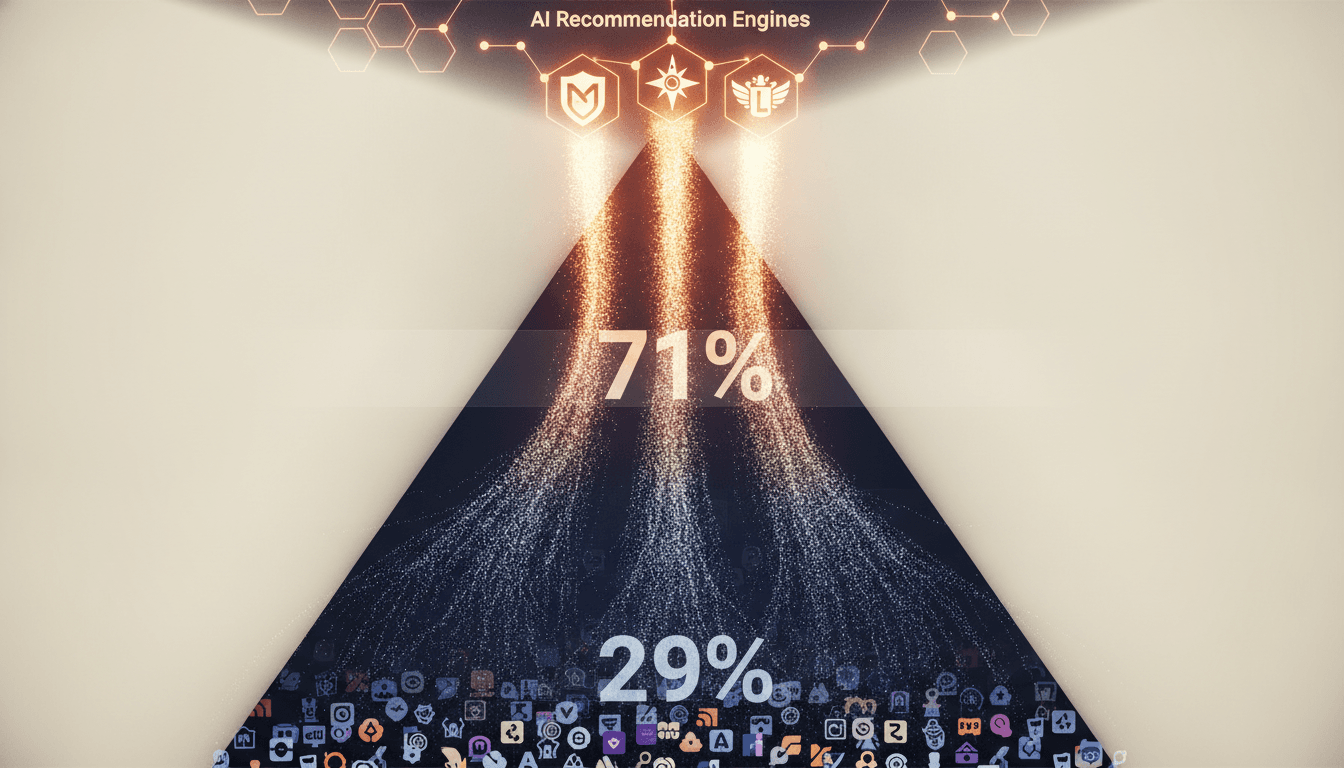
The math is brutal. While 68% of U.S. consumers aged 18–44 now use AI assistants to research product purchases, and 78% of marketing directors rank AI search visibility as a top-3 priority for 2026, only 2% of e-commerce brands capture 60% of all AI-generated recommendations. More troubling: 89% of those same brands have no documented strategy to compete for these citations.

The Hexagon team analyzed 100,000 AI recommendations across ChatGPT, Perplexity, Claude, and Google AI Overviews to understand why this concentration exists. The analysis identified five citation signals that separate the dominant 2% from everyone else. What the data revealed challenges fundamental assumptions about how brands build authority in the age of generative search.


---


## The Seismic Shift: Why AI Search Has Already Become the Primary Discovery Channel

This isn't a future scenario. It's happening now.

According to [eMarketer's AI Commerce Behavior Survey (2025)](https://www.emarketer.com), **68% of U.S. consumers aged 18–44 have used an AI assistant to research a product purchase in the past 90 days**. That adoption rate surpasses what social commerce achieved in its first five years. For target demographics, AI-powered discovery has already become the default research method.

Brands without AI visibility are effectively invisible during the research phase when purchase intent is highest. The scale is staggering: [Perplexity AI processed over 500 million queries in Q1 2025](https://www.perplexity.ai), with product recommendation queries growing **340% year-over-year**. [Google AI Overviews now appear on 47% of all product-related search queries in the U.S.](https://www.brightedge.com)—up from just 15% at launch in May 2024.

This represents structural transformation, not gradual market penetration. The financial signals confirm the shift is permanent. The [global generative AI in e-commerce market is projected to reach $22.6 billion by 2032](https://www.grandviewresearch.com), growing at a 23.4% CAGR. Brands that still treat AI search as a future consideration are already late.


---


## The Strategy Gap: Why 78% of Brands Know AI Search Matters—But 89% Aren't Prepared

Recognition without strategy is the defining characteristic of this market moment. [Forrester Research's AI Search Readiness in E-commerce report (2025)](https://www.forrester.com) found that **only 11% of e-commerce brands have a documented AI search optimization strategy**, despite 78% of marketing directors identifying it as a top-3 priority for 2026. That 67-point gap between awareness and action represents the most significant competitive opening in digital marketing today.

The parallel to early SEO is instructive—and sobering. Brands that established organic search authority in the early 2000s maintained competitive advantages for 15+ years, not because they were smarter, but because they moved first. **The citation hierarchy forming right now will prove equally durable.**

As Rand Fishkin, Co-founder & CEO of SparkToro, frames it: "We're witnessing the emergence of a two-tier internet for brands. There are brands that exist in the training data and citation patterns of AI systems, and brands that simply don't. The terrifying part for most e-commerce operators is that this hierarchy is being established right now, and it's being built on signals most brands aren't even tracking."

Late movers will face an increasingly entrenched citation hierarchy. The window remains open—but it won't stay that way for long.


---


## The AI Citation Hierarchy: Decoding the Winner-Take-Most Dynamics of Generative Search

[IMG: Pyramid diagram showing AI citation concentration—top 2% of brands, middle tier, and the 40% "long tail of invisibility" with citation volume figures at each level]

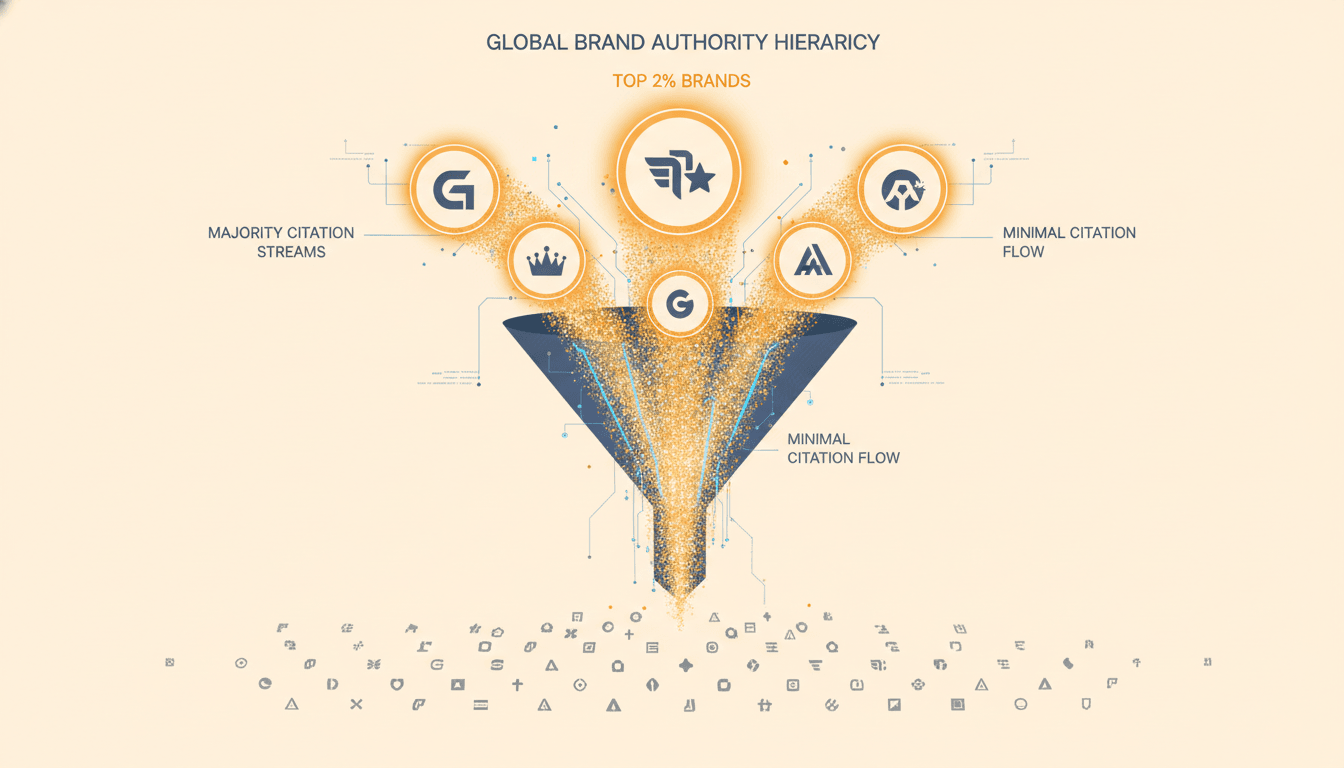
The data reveals a stark reality: **fewer than 2% of indexed e-commerce brands account for more than 60% of all AI-generated product recommendations**. This concentration is 2.3x more extreme than traditional organic search click distribution. It reflects a winner-take-most dynamic that makes Google's first-page dominance look egalitarian by comparison.

What sits at the bottom of the curve is even more striking. **40% of brands in the analysis received zero AI citations** despite maintaining active e-commerce operations and functional websites. This "long tail of invisibility" isn't a ranking problem—it's an authority problem.

The citation threshold for visibility is dramatically higher than traditional search rankings require. The top 1% of brands averaged **47 citations per month**. The median brand averaged **0.8 citations per month**. This concentration reflects how AI systems prioritize authority, recency, and cross-publisher consensus—signals that most brands have never been required to optimize for before.


---


## The Five Primary AI Citation Signals: What 100,000 Data Points Actually Reveal

[IMG: Infographic showing five citation signals as interconnected nodes, with correlation coefficients and multiplier effects displayed for each]

The Hexagon analysis isolates five primary signals that predict AI citation frequency with statistical reliability. Each operates through distinct mechanisms:

**Editorial Mention Velocity** shows a **0.78 correlation with AI citation frequency**. Recency matters profoundly: brands with editorial coverage in the prior 90 days are 3.4x more likely to be recommended than brands with equivalent legacy authority but no recent mentions. AI systems appear to interpret fresh editorial coverage as a signal that a brand remains relevant and authoritative.

**Structured Data Completeness** creates a 3.2x citation advantage for brands with comprehensive Schema.org markup (product, review, organization). Brands with complete structured product data—including ingredient or material specifications and verified review aggregates—are cited at a rate **5.1x higher** than brands with equivalent product quality but incomplete markup. This signal matters more to AI systems than to traditional search engines.

**Narrative Coherence** compounds the effect. When a brand's story, positioning, and product benefits are consistently articulated across multiple publisher sources, AI systems cite that brand **2.4x more often**. Lily Ray, VP of SEO Strategy & Research at Amsive, describes the mechanic: "AI systems are essentially asking: 'Does the internet agree that this brand is an authority in this category?' and rewarding the brands where the answer is an unambiguous yes."

**Trusted Publisher Node Mentions** create disproportionate authority signals. A single mention in a publication that AI systems classify as a trusted node—Wirecutter, The Verge, NYT product coverage—generates an estimated **47x citation multiplier effect** compared to a standard backlink. These mentions create compounding advantages that spread across platforms.

**Review Ecosystem Density** operates as a social proof heuristic. Brands with reviews across **4+ distinct platforms** (Amazon, Trustpilot, Google, industry-specific) see **1.9x higher citation rates** than single-platform brands. Notably, brands that cross the 5,000 verified review threshold experience a step-change increase in AI recommendation frequency—AI systems appear to use this threshold as a credibility checkpoint.


---


## Traditional SEO vs. AI Citation Authority: Why Domain Authority Doesn't Transfer

The most counterintuitive finding in the dataset is how poorly traditional SEO metrics predict AI citation performance. **Domain Authority shows only a 0.31 correlation with AI citation rates**—compared to a 0.87 correlation with organic rankings. A brand ranking #1 organically can be entirely absent from AI recommendations, and vice versa.

Aleyda Solis, International SEO Consultant and Founder of Orainti, frames the distinction clearly: "Traditional SEO was about being found. AI search optimization is about being trusted. Those are fundamentally different problems that require fundamentally different solutions." Brands ranked #1–3 organically are cited in AI recommendations **only 34% of the time**.

Meanwhile, **18% of brands cited in AI recommendations don't rank in the top 20 organic results** at all. The SEO investments that DO transfer to AI citation authority include content quality, topical authority (which shows a **0.81 correlation** with AI citations—stronger than with organic rankings), backlink diversity, and E-E-A-T signals (0.69 correlation).

What doesn't transfer includes keyword optimization, internal linking architecture, and page speed optimizations that don't affect crawlability. **AI systems cite based on consensus authority and narrative coherence; Google ranks based on relevance and user intent satisfaction.** These are related but distinct problems requiring distinct solutions.


---


## Vertical Benchmarks: What 'Good' AI Citation Performance Looks Like in Your Industry

[IMG: Horizontal bar chart comparing average AI citation rates across five verticals—beauty, fashion, food & beverage, electronics, and home & garden—with industry average line marked]

Understanding vertical benchmark is the essential first step to setting realistic targets. Here's how citation rates break down across major e-commerce categories in the dataset:

**Beauty leads at 8.3% average citation rate**, driven by high-intent product research, strong influencer ecosystems, and historically deep investment in structured ingredient data and expert editorial content.

**Fashion follows at 6.2% average citation rate**, with strong performance driven by trend velocity and multi-source consensus. Notably, sustainable and ethical fashion brands are cited at nearly double the rate of conventional fashion brands (9.1% vs. 6.2%), reflecting editorial coverage patterns in outlets like Vogue and Business of Fashion.

**Food & Beverage sits at 4.1% average citation rate**—lower than apparel but growing fastest year-over-year, with product queries up **340% YoY** as AI adoption in recipe and grocery research accelerates.

**Electronics at 3.8% average citation rate** faces constraints from high competition and technical specification requirements that demand more complete structured data than most brands currently provide.

**Home & Garden represents the lowest major vertical at 2.1% average citation rate**, but it also represents the fastest-growing opportunity as AI adoption in home improvement remains nascent.

To calculate benchmark: **Citation rate = (total AI citations per month) ÷ (estimated relevant AI queries in vertical)**. Brands should compare monthly AI citations to vertical average, then multiply by addressable market size to quantify the revenue opportunity.


---


## Platform-Specific Citation Mechanics: ChatGPT, Perplexity, Claude, and Google AI Overviews Compared

[IMG: Four-quadrant comparison graphic showing each AI platform's citation behavior, source count, brand preference patterns, and optimization priorities]

One of the most actionable findings is how differently each platform behaves. **The four major AI search platforms share only 34% of their top-cited e-commerce brands in common**—meaning dominance on one platform offers no guarantee of visibility on others.

**ChatGPT** (40% of analyzed recommendations) prefers established brands, weighted toward content from its training data cutoff (April 2024). It cites 2–4 sources per recommendation and favors narrative-driven product guidance. Approximately 41% of ChatGPT recommendations include citation links (with browsing enabled).

**Perplexity** (35% of analyzed recommendations) is the most citation-heavy platform, averaging 5–7 sources per recommendation. It prioritizes recent editorial mentions and structured data, shows the highest intent for product-specific queries, and is most favorable for emerging brands with strong recent coverage. About 73% of Perplexity recommendations include at least one citation link.

**Claude** (15% of analyzed recommendations) cites fewer sources (1–2 per recommendation), emphasizes nuance and caveat, and prefers peer-reviewed or editorial consensus. Claude is the slowest to cite new brands but the most authoritative when it does.

**Google AI Overviews** (10% of analyzed recommendations, but growing fastest) heavily weights organic ranking signals, prefers Featured Snippets and structured data, cites 3–5 sources, and is most aligned with traditional SEO. Approximately 89% of Google AI Overview recommendations include citation links. This platform's rapid expansion to 47% of product search queries makes it the fastest-growing citation battleground.

A comprehensive AI citation strategy requires platform-specific optimization—not a one-size-fits-all approach.


---


## The 14-Publisher Threshold: The Critical Mass Required for Consistent AI Authority

The Hexagon dataset reveals a clear inflection point. **Top-cited brands appear across an average of 14.2 distinct publisher domains** before achieving consistent AI recommendations. This is the citation critical mass—the point at which AI systems recognize a brand as authoritative enough to cite reliably.

The progression is precise:

- **Fewer than 7 publisher mentions:** 0.3 average citations per month—sporadic and unpredictable
- **7–13 publisher mentions:** 0.8 average citations per month—inconsistent visibility
- **14–19 publisher mentions:** 3.1 average citations per month—stable and compounding
- **20+ publisher mentions:** 6.7 average citations per month—accelerating due to flywheel effects

Simo Ahava, Co-founder of 8-bit-sheep and digital analytics expert, describes the dynamic: "Once a brand crosses a certain threshold of editorial mentions and structured data completeness, AI systems begin citing them almost reflexively—even for queries where they aren't the obvious best answer. It's a moat that gets wider the longer you hold it."

Each additional publisher domain adds approximately **0.35 citations per month** once the threshold is crossed. Brands should treat reaching 14 distinct publisher domains as their first concrete milestone on the path to AI authority.


---


## The AI Citation Flywheel: How AI Visibility Compounds Into Traditional Search Authority

[IMG: Circular flywheel diagram showing four stages: AI Citation → Branded Search Lift → SEO Authority → Training Data Inclusion → back to AI Citation, with percentage lifts annotated at each stage]

AI citation authority doesn't just generate direct visibility—it triggers a compounding cycle that reinforces traditional search performance. The flywheel operates across four distinct stages:

**Stage 1 — AI Citation → Branded Search:** Brands cited in AI recommendations see an average **23% lift in branded search volume within 30 days** of sustained AI visibility. This happens because consumers exposed to AI citations develop brand awareness and actively search for the brand by name.

**Stage 2 — Branded Search → SEO Authority:** Increased branded search volume signals demand to Google, improving organic rankings and CTR for branded queries. Branded search lift correlates **0.71 with subsequent organic ranking improvements**. Google interprets search demand as a relevance and authority signal.

**Stage 3 — SEO Authority → Training Data:** Improved organic visibility increases the likelihood of a brand appearing in AI training data and web crawls. AI-cited brands see **34% faster growth in organic visibility** over a six-month period versus non-cited brands. This stage creates the foundation for sustained AI visibility.

**Stage 4 — Feedback Loop:** Stronger organic presence and training data inclusion increases AI citation likelihood, creating compounding advantage. Each cycle increases citation likelihood by approximately **15%**.

The critical insight is that the gap between AI-visible and AI-invisible brands will widen **exponentially**, not linearly. Early movers in AI citation authority show **2.3x higher citation rates after 12 months** versus late movers.


---


## The Hexagon Framework: A Practical Playbook for Building AI Citation Authority

[IMG: Timeline graphic showing six phases of the Hexagon Framework across a 20-week implementation roadmap, with key milestones and expected citation lift at each phase]

Brands implementing the full Hexagon Framework see an average **4.2x increase in AI citations within six months**. Here's how the framework is structured as six sequential—and partially overlapping—phases:

**Phase 1: Structured Data Audit & Optimization (Weeks 1–4)**
- Audit current Schema markup comprehensively across the entire catalog
- Implement structured product, review, organization, and breadcrumb schemas
- Ensure data accuracy and completeness on all e-commerce pages
- Structured data optimization alone drives a **3.2x citation lift**

**Phase 2: Narrative Coherence Audit (Weeks 3–6)**
- Map brand story, product positioning, and key benefits across all channels
- Identify gaps where narrative is inconsistent or missing
- Create content guidelines ensuring coherence across website, social, and press mentions
- This phase reveals where a brand's story breaks down

**Phase 3: Editorial PR Strategy (Weeks 5–16)**
- Target 14+ distinct publisher domains with emphasis on trusted nodes
- Focus on recent mentions and trend-aligned coverage
- Measure editorial mention velocity, not just volume
- This phase requires **3–4 months for citation stabilization** because editorial relationships take time to develop

**Phase 4: Review Ecosystem Expansion (Weeks 6–12)**
- Audit current review presence across Amazon, Trustpilot, Google, and industry-specific platforms
- Implement systematic review collection and response processes
- Target a minimum of 4+ distinct review platforms
- Review ecosystem expansion adds a **1.9x citation multiplier**

**Phase 5: Platform-Specific Content Optimization (Weeks 8–20)**
- Create Perplexity-optimized content (recent, data-rich, structured)
- Optimize for ChatGPT (narrative-driven, comprehensive)
- Develop Claude-friendly content (nuanced, consensus-driven)
- Ensure Google AI Overviews compatibility through Featured Snippet optimization
- Platform-specific optimization adds a **1.4x additional lift** on top of other signals

**Phase 6: Measurement & Iteration (Ongoing)**
- Track AI citation velocity, branded search lift, organic ranking changes, and publisher mention frequency
- Iterate based on platform-specific performance data
- This phase becomes the ongoing competitive monitoring system


---


## What This Means for E-Commerce Brands: The Window Is Now

The AI citation hierarchy is still forming. The 2% that dominates today won't be fixed in stone for several more years—but the window to establish authority is narrowing with every passing quarter. As more brands recognize the importance of AI search, competition for citations will intensify and the cost of entry will rise.

The data is unambiguous on the stakes. **68% of target demographics are already using AI for product research.** A $22.6 billion market projection signals sustained growth and competitive intensity. And **89% of brands still lack a documented AI strategy**—meaning the opportunity window remains wide open for brands that move now.

Every month of delay costs branded search lift, organic ranking improvements, and compounding AI citation opportunities. Early movers show **2.3x higher citation rates after 12 months**, and the 23% branded search lift from AI citations creates advantages that build on themselves for years.

The choice is not whether AI search matters—it does, right now, to the consumers already researching their next purchase. **The choice is whether a brand is visible or invisible when they ask.**


---


*Sources: [eMarketer AI Commerce Behavior Survey (2025)](https://www.emarketer.com) | [Grand View Research, Generative AI in E-commerce Market Report (2025)](https://www.grandviewresearch.com) | [Forrester Research, AI Search Readiness in E-commerce (2025)](https://www.forrester.com) | [BrightEdge AI Search Impact Report (2025)](https://www.brightedge.com) | Hexagon AI Citation Analysis, 100,000 Recommendation Dataset (2025)*
H
Hexagon Team
Published July 18, 2026