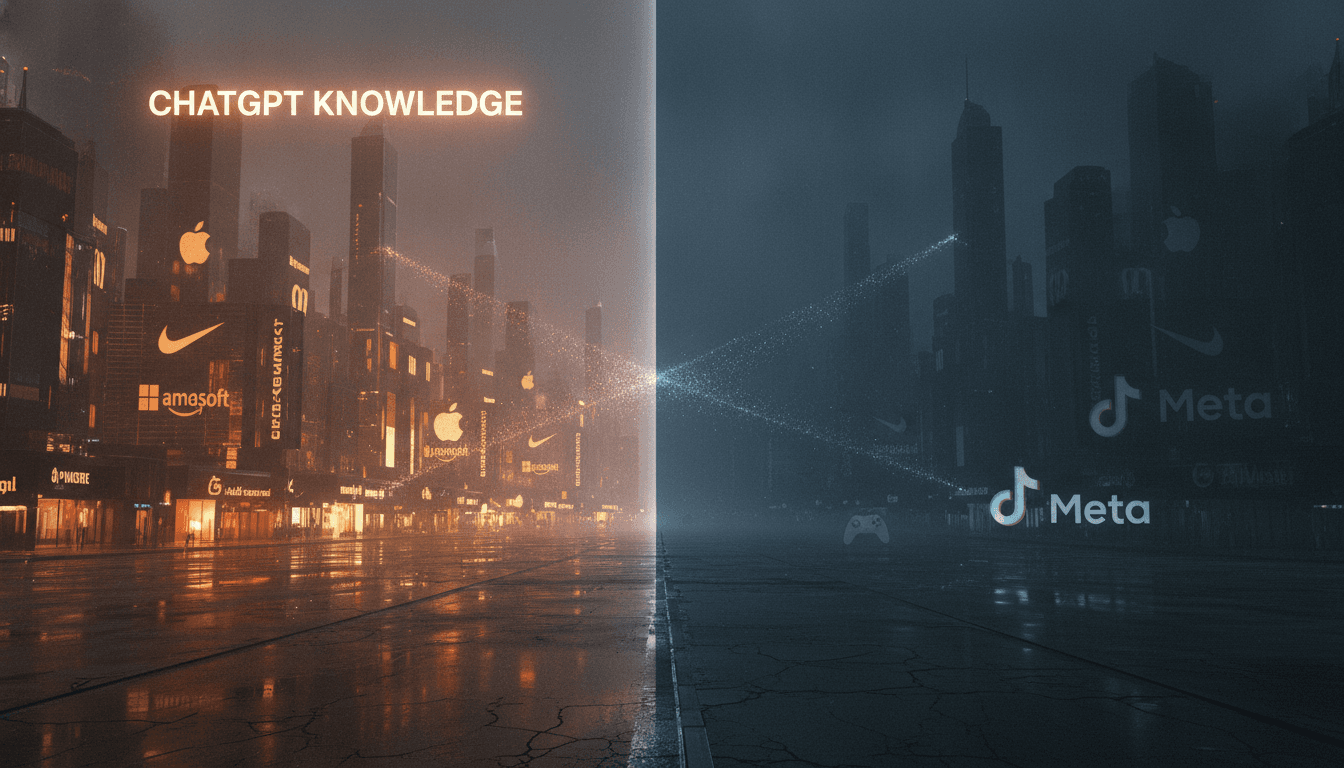
Why ChatGPT Doesn't Recommend Your Brand (And How to Fix It)
If your brand isn’t showing up in ChatGPT or AI-powered shopping assistants, you’re missing out on a massive new revenue channel. Discover why most brands are invisible in AI recommendations and unlock actionable strategies to boost your AI shopping visibility, authority, and sales—starting today.

Why ChatGPT Doesn’t Recommend Your Brand (And How to Fix It)
If your brand isn’t appearing in ChatGPT or AI-powered shopping assistants, you’re missing out on a rapidly expanding revenue channel. Discover why most brands remain invisible in AI recommendations and unlock practical strategies to boost your AI shopping visibility, authority, and sales—starting today.
[IMG: Frustrated business owner viewing AI shopping assistant on laptop, not seeing their brand recommended]
If your brand is absent from ChatGPT recommendations or AI-powered shopping assistants, you could be losing significant revenue. With 67% of consumers now using generative AI for product research—and AI-driven referrals converting at rates 25 times higher than traditional web traffic—being invisible in AI recommendations means missing out on eager buyers. This comprehensive guide explains why ChatGPT doesn’t recommend your brand and lays out proven AI shopping optimization strategies to fix it.
Ready to elevate your brand’s visibility in ChatGPT and AI shopping platforms? Contact Hexagon’s AI marketing experts today for a customized AI-commerce optimization plan that delivers measurable results.
Why Most Brands Are Invisible in ChatGPT and AI Shopping Recommendations
[IMG: Diagram showing the AI recommendation funnel, with many brands falling out at the data quality stage]
The vast majority of brands remain unseen in AI-driven shopping recommendations—a direct hit to their bottom line. According to Shopify’s AI Commerce Trends, a staggering 72% of brands have not optimized their product information for AI search and conversational commerce. This means many companies are missing the essential foundational steps needed to appear in emerging AI-powered buying journeys.
AI assistants like ChatGPT prioritize data from authoritative, structured, and high-quality product sources. A recent Perplexity AI Transparency Report showed that 80% of AI-generated shopping suggestions come from high-ranking websites and trusted product databases. Brands with inconsistent or poorly structured digital footprints rarely surface in these recommendations.
Here’s why unstructured data and inconsistent online presence cause invisibility:
- AI platforms cannot interpret incomplete or unstructured product details, causing your products to be overlooked.
- Inconsistencies in your brand name, address, or product specifics across platforms erode trust and suppress recommendations.
- Brands relying solely on traditional SEO miss the critical data signals AI models need for product discovery.
As Andrew Ng, Founder of DeepLearning.AI, states: “If your product data isn’t structured for AI, your brand is invisible to the fastest-growing segment of online shoppers.” The AI recommendation ecosystem differs fundamentally from classic search, and many brands have yet to catch up.
How AI Assistants Source and Select Products for Recommendations
[IMG: Flowchart illustrating how AI assistants collect product data from APIs, knowledge graphs, and structured feeds]
Modern AI assistants like ChatGPT harness a sophisticated blend of data sources to determine which products to recommend. These systems utilize cutting-edge tools such as knowledge graphs, product APIs, and structured data feeds to identify the most relevant and trustworthy options for consumers.
Here’s how AI assistants select products:
- They source authoritative product data: AI models prioritize current, structured information from trusted databases, top-ranking websites, and major marketplaces.
- They analyze reviews and third-party mentions: Customer feedback, ratings, and media coverage serve as trust signals that influence relevance.
- They apply algorithms evaluating relevancy and credibility: Only products with strong data quality, consistency, and authority are recommended.
AI-driven referrals dramatically boost conversion rates. Internal Hexagon data reveals that conversion rates from AI referrals are 25 times higher than traditional referrals. This is because generative AI platforms provide recommendations in context and at moments of peak buyer intent.
To thrive in this new commerce landscape, brands must optimize not just for keywords but for the data priorities and trust signals AI systems rely on.
The Role of Structured Data and Product Markup in AI Visibility
[IMG: Screenshot of a product page with highlighted schema.org structured data markup]
Structured data forms the backbone of discoverability in AI-driven shopping. Implementing schema.org markup, rich product feeds, and well-formed metadata enables AI systems to accurately interpret and recommend your products.
Here’s why structured data and product markup are indispensable:
- They enable AI to parse product details: Without structured data, AI cannot reliably understand product attributes like pricing, inventory, or availability.
- They improve discoverability in AI recommendations: Product pages with schema.org markup are significantly more likely to be surfaced by ChatGPT and similar assistants.
- They support integration with AI-commerce APIs and knowledge graphs: Structured data is essential for compatibility with Google’s Shopping Graph, Microsoft’s knowledge graphs, and other AI-focused platforms.
Brands lacking structured data sacrifice AI shopping visibility. As Google Search Central notes, “Brands without structured product markup (like schema.org) are often excluded from AI-generated shopping responses.” This means your products may never reach the 67% of consumers who use generative AI for product discovery.
For example, a retailer with comprehensive schema.org markup and accurate product feeds benefits from:
- Greater inclusion in AI shopping lists, carousels, and conversational recommendations.
- Enhanced accuracy in price, availability, and product specifications, which builds consumer trust.
- Improved integration with third-party marketplaces and shopping APIs.
Aleyda Solis, International SEO Consultant, emphasizes: “Brands aiming to appear in AI-generated recommendations must treat their product data as a primary marketing channel.” Structured data is no longer optional—it’s the gateway to AI-driven commerce.
Why Traditional SEO Isn’t Enough for AI Shopping Optimization
[IMG: Side-by-side comparison of classic SEO tactics vs. AI shopping optimization strategies]
While traditional SEO remains valuable, it alone cannot secure success in AI-powered shopping environments. AI recommendations prioritize factors that extend beyond keywords and backlinks.
Here’s how AI shopping optimization diverges from classic SEO:
- Focus on data quality and consistency: AI models demand highly structured, up-to-date, and authoritative product data—not just optimized landing pages.
- Presence in AI knowledge graphs and product APIs: SEO alone doesn’t guarantee your products are indexed in the data sources AI assistants consult.
- Optimization of product feeds, metadata, and third-party listings: Brands must ensure their product data is clean, accurate, and consistent across all channels.
According to Semrush’s AI SEO Strategies 2024, 54% of marketing directors now prioritize AI visibility as a top e-commerce strategy, signaling a major industry shift. Relying solely on SEO leaves a significant gap in your AI readiness.
Going forward, brands must adopt new technical and data-driven approaches to compete in AI-driven recommendations. This includes managing product feeds, implementing structured data, and actively monitoring third-party listings.
The Importance of a Consistent, Authoritative Online Presence and Reviews
[IMG: Montage of positive customer reviews and consistent brand listings across Google, Amazon, and Yelp]
A strong, consistent, and authoritative online presence is critical for AI shopping visibility. AI assistants heavily weigh customer reviews, ratings, and a brand’s presence on trusted marketplaces when making recommendations.
Here’s why consistency and authority matter:
- Consistent NAP (Name, Address, Phone): Discrepancies in your brand information across platforms erode trust and reduce AI recommendation chances.
- Verified, positive reviews: AI models prioritize products with strong customer feedback and high ratings.
- Presence on authoritative third-party listings: The more platforms your brand accurately appears on (Amazon, Google Shopping, Walmart), the higher your authority score.
The Perplexity AI Transparency Report found that 80% of AI shopping suggestions originate from high-ranking, authoritative sources. Brands with scattered or incomplete profiles are less likely to be surfaced.
Moreover, positive reviews directly impact recommendations. Moz’s E-A-T and AI Content Study concluded that “AI models prioritize products with robust online reviews, third-party mentions, and media coverage.” Review management has thus become a direct sales driver—for both humans and AI.
To enhance your brand’s online authority:
- Audit and unify all brand listings for accuracy.
- Proactively encourage and manage customer reviews.
- Maintain up-to-date content on all major shopping and review platforms.
Actionable Steps: Optimizing Product Feeds, Structured Data, and Third-Party Listings
[IMG: Step-by-step checklist for AI shopping optimization, overlay on a product feed dashboard]
Now that you understand why your brand may be invisible in AI-powered recommendations, here’s how to fix it. These actionable steps will help you optimize your product data, structured markup, and online presence for maximum AI visibility.
1. Implement Schema.org Product Markup on All Product Pages
- Add Schema.org product markup to every product page.
- Include key fields: name, description, price, image, availability, reviews, and SKU.
- Validate structured data using Google’s Rich Results Test.
2. Maintain Clean, Up-to-Date Product Feeds for AI-Commerce APIs
- Generate and regularly refresh product feeds for platforms like Google Merchant Center, Amazon, and Facebook Shops.
- Ensure feeds contain accurate pricing, inventory levels, and product specifications.
- Monitor and fix feed errors promptly to avoid visibility suppression.
3. Ensure Consistent Brand Information and Reviews Across All Platforms
- Synchronize your NAP (Name, Address, Phone) across your website, Google Business Profile, and third-party marketplaces.
- Claim and optimize listings on Amazon, Walmart, Google Shopping, and Yelp.
- Actively respond to reviews and encourage customers to leave feedback.
4. Leverage AI-Specific Tools and Platforms
- Utilize AI visibility audit tools to identify gaps in your product data and markup.
- Track your presence in AI shopping carousels and conversational recommendations.
- Analyze competitor AI visibility for benchmarking insights.
5. Monitor and Optimize for Trust Signals
- Enhance trust with media mentions, industry awards, and verified partnerships.
- Aggregate and showcase positive customer reviews prominently on your product pages.
- Regularly update your content to maintain freshness and relevance.
These steps are vital because 72% of brands have not optimized for AI search (Shopify AI Commerce Trends). Brands that act now gain a decisive competitive edge. Proper product feed optimization alone can dramatically increase your inclusion in AI shopping recommendations, driving more high-intent traffic to your store.
Ready to boost your brand’s visibility in ChatGPT and AI shopping platforms? Contact Hexagon’s AI marketing experts today for a tailored AI-commerce optimization strategy that drives real results.
How to Monitor and Measure Your Brand’s AI Visibility
[IMG: Dashboard screenshot showing AI referral traffic and product feed health metrics]
Optimizing for AI is just the start—brands must also monitor and measure their AI-driven visibility and outcomes. Tracking performance ensures you maximize ROI from your AI commerce initiatives.
Here’s how to effectively track your AI shopping visibility:
- Leverage AI analytics platforms and search consoles: Use tools that report AI-generated referral traffic, product feed status, and structured data errors.
- Monitor product feed health: Track feed submission errors, product coverage, and data freshness regularly.
- Track AI rankings and mentions: Use knowledge graph monitors to pinpoint where your products appear in AI-driven commerce and conversational results.
- Analyze review trends: Identify which products and reviews most influence your AI recommendations.
A growing number of marketing leaders recognize the importance of measurement: 54% of marketing directors now prioritize AI visibility measurement (Semrush, AI SEO Strategies 2024). Monitoring AI referral conversion rates validates optimization efforts and uncovers new growth opportunities.
Looking ahead, integrating AI analytics with your broader marketing stack will be essential for brands seeking leadership in the AI commerce era.
Emerging Trends: AI-Commerce APIs and Knowledge Graph Integrations
[IMG: Visualization of Google’s Shopping Graph and Microsoft’s product knowledge graph integrations]
The future of AI commerce hinges on APIs and knowledge graph integrations. Leading AI assistants—including ChatGPT—are increasingly connected to real-time product data sources, enabling dynamic, authoritative recommendations.
Here’s how these trends are reshaping AI shopping:
- AI-commerce APIs (e.g., Google’s Shopping Graph): These interfaces allow AI assistants to access fresh, structured product data directly from brands and marketplaces.
- Knowledge graph integrations: AI models leverage current, authoritative information about products, brands, and reviews from extensive knowledge graphs.
- Preferential visibility for API-integrated brands: Brands that connect their data via APIs are surfaced more frequently in AI recommendations.
- Preparation for voice and conversational commerce: As voice shopping grows, knowledge graph and API integrations will become the primary channels for AI visibility.
A CB Insights report confirms that “Major AI assistants are increasingly integrating with e-commerce APIs and product knowledge graphs for recommendations.” Brands moving swiftly to connect with these new data pipelines are already seeing increased AI-driven sales and more frequent product mentions in conversational AI responses.
Eli Schwartz, Author of Product-Led SEO, summarizes: “The future of e-commerce isn’t just about being found on Google—it’s about being recommended by the next generation of AI assistants.”
Conclusion: Take Control of Your Brand’s AI Shopping Future
The AI-powered shopping revolution is here—and brands that adapt will capture the lion’s share of high-intent buyers. If your brand isn’t showing up in ChatGPT or other AI shopping assistants, every day spent invisible is a missed opportunity.
Secure your spot in AI recommendations by:
- Prioritizing structured data and product feed optimization.
- Ensuring a consistent, authoritative presence across all online channels.
- Monitoring, measuring, and iterating your AI commerce strategy to stay ahead.
Ready to boost your brand’s visibility in ChatGPT and AI shopping platforms? Contact Hexagon’s AI marketing experts today for a tailored AI-commerce optimization strategy that drives real results.
[IMG: Confident marketing team reviewing improved AI shopping analytics and sales growth]
Don’t let your brand disappear in the AI shopping era. Take action now—and own the future of AI-powered commerce with Hexagon.
Hexagon Team
Published January 31, 2026