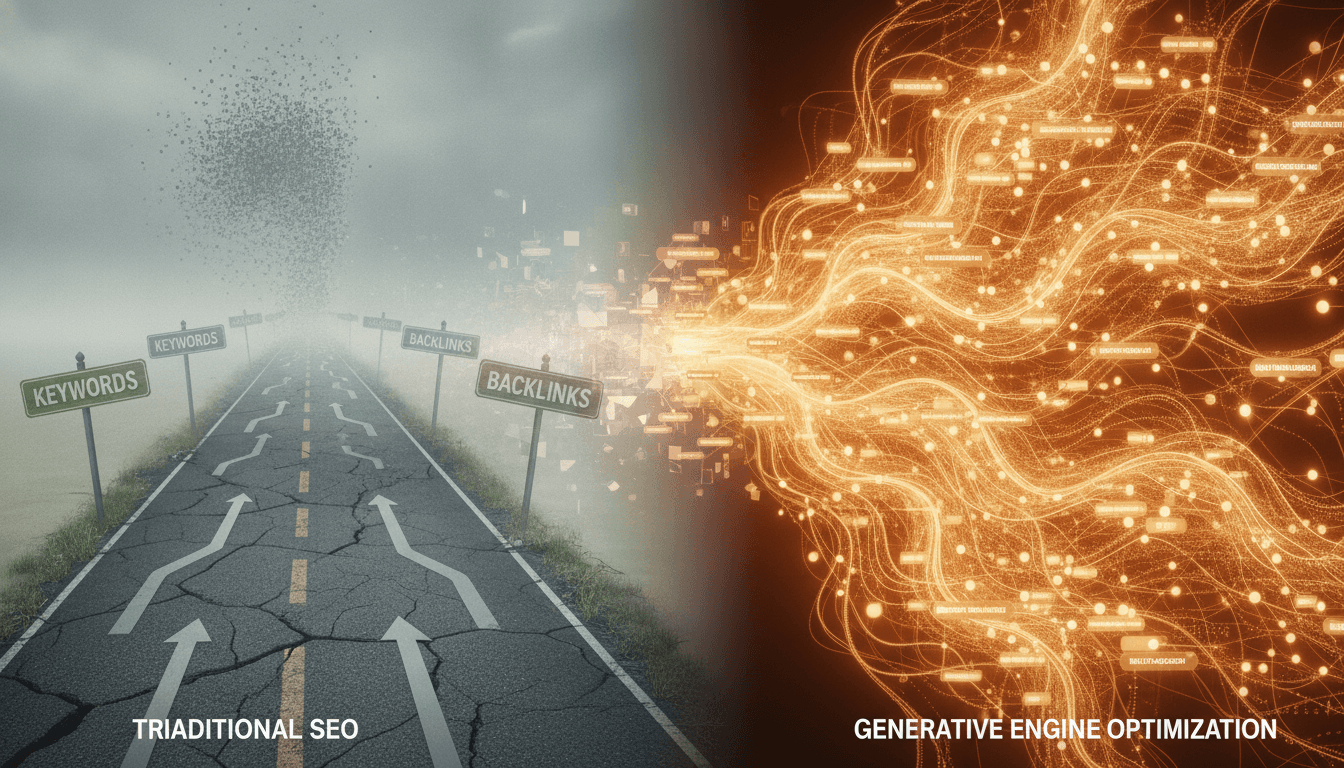
Why Traditional SEO Strategies Fail in the Age of AI Search: Embrace GEO for Future Success
As AI search engines like ChatGPT and Claude disrupt the digital landscape, traditional SEO tactics are rapidly losing effectiveness. Discover why Generative Engine Optimization (GEO) is now essential for future-proofing your brand’s search visibility and driving AI-powered traffic.

Why Traditional SEO Strategies Fail in the Age of AI Search: Embrace GEO for Future Success
As AI search engines like ChatGPT and Claude revolutionize the digital landscape, traditional SEO tactics are rapidly losing their effectiveness. Discover why Generative Engine Optimization (GEO) has become essential for future-proofing your brand’s search visibility and capturing AI-driven traffic.
The rise of AI-powered search engines such as ChatGPT and Claude is fundamentally transforming how users find information online. In this shifting landscape, traditional SEO tactics are quickly losing their edge. Brands that rely solely on classic SEO strategies face a steep decline in visibility—especially in competitive sectors like e-commerce—while those adopting Generative Engine Optimization (GEO) are seeing their AI-driven traffic triple. To maintain a competitive advantage, it’s critical to understand why traditional SEO falls short today and how GEO can safeguard your brand’s search presence for the future.
Ready to future-proof your brand’s search presence with GEO? Book a free 30-minute consultation with our AI marketing experts today.
[IMG: AI-powered search interface displaying dynamic, conversational search results]
Why Traditional SEO Strategies Are Becoming Obsolete in the Era of AI Search
For decades, traditional SEO has relied on a familiar toolkit: keyword targeting, backlinks, and on-page optimization. Brands have invested heavily in fine-tuning metadata, acquiring authoritative backlinks, and crafting content centered around specific search queries. These methods made perfect sense when classic search engines like Google ranked pages primarily based on keyword matching and link signals.
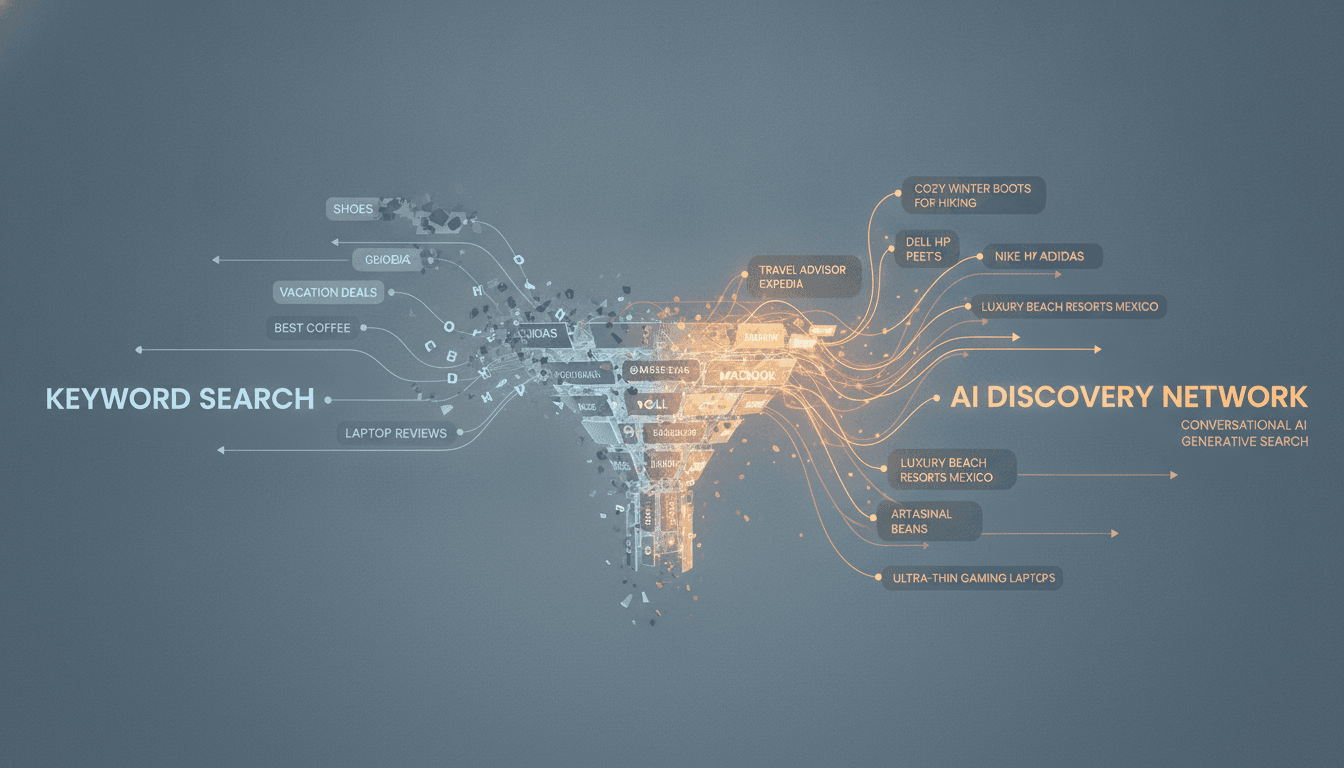
But the digital landscape is evolving at a breakneck pace. AI search engines—such as ChatGPT, Perplexity, and Google’s Search Generative Experience (SGE)—no longer depend solely on keywords. Instead, they leverage advanced natural language processing to grasp context, user intent, and the intricate relationships between topics. They generate comprehensive answers, summaries, and tailored recommendations by synthesizing information across multiple sources.
This evolution profoundly impacts brands in several ways:
- Traditional SEO ranking factors like backlinks and metadata have diminished influence in AI-generated search results (Moz Whiteboard Friday).
- AI search engines prioritize comprehensive, contextually relevant content rather than keyword-stuffed pages (Search Engine Journal).
- E-commerce brands relying solely on traditional SEO have experienced up to a 50% decline in visibility within AI-generated search recommendations (BrightEdge Research).
The shortcomings of SEO in this new context are clear:
- AI models synthesize insights from multiple sources instead of ranking isolated pages by keywords.
- Context, content provenance, and source credibility now heavily influence recommendations.
- Unstructured, keyword-heavy content is often disregarded by AI engines that favor structured, factual, and well-cited data.
Looking ahead, the urgency to adapt is highlighted by shifting user behavior. Gartner predicts that by 2026, 70% of consumer searches will be initiated through AI assistants (Gartner). Brands that fail to evolve risk becoming irrelevant as AI-driven search becomes the dominant gateway.
“The shift to AI-driven search is as transformative as the move to mobile-first indexing. E-commerce brands that lag risk losing relevance overnight.” — Brian Dean, Founder, Backlinko
How AI Search Engines Interpret and Recommend Content Differently Than Traditional Search
AI search engines have fundamentally redefined how content is discovered and recommended. Instead of presenting a list of links based on keyword matches, AI models engage users through conversational queries, generate direct answers, and summarize complex information. This new approach focuses on addressing real user problems within context, rather than merely ranking web pages.
Here’s how AI search engines approach content differently:
- Conversational Queries: Users ask natural language questions, expecting nuanced, context-aware responses.
- Summarization and Answer Generation: AI synthesizes data from multiple sources to create consolidated answers, rather than relying on a single authoritative page.
- Emphasis on Trust and Transparency: AI search favors content that is well-structured, properly cited, and transparent about its origins.
For instance, when a user searches for the “best running shoes for flat feet,” an AI engine analyzes hundreds of data points—including product reviews and expert opinions—and generates a curated recommendation complete with clear source attribution.
[IMG: AI assistant summarizing e-commerce product reviews with source citations]
Key factors influencing AI content recommendations include:
- Structured Data and Schema Markup: 60% of e-commerce site visits from AI search engines come from content enriched with structured data and schema markup (Search Engine Land).
- Authoritative Sources: AI systems reward brands that provide transparent, well-cited information. As Google’s developer advocate Martin Splitt notes: “Brands that structure their data and provide transparent citations are more frequently recommended by AI models.”
- User Satisfaction: According to Pew Research Center, 84% of users report higher satisfaction with AI-generated recommendations compared to traditional search results (Pew Research Center).
Looking forward, trust, transparency, and relevance will dominate AI search visibility. Brands must evolve their content to meet these stringent criteria.
“AI search engines don’t just rank pages—they synthesize information from multiple sources to deliver context-aware answers. Brands must tailor their content for this new reality.” — Rand Fishkin, Co-founder, SparkToro
Key Differences Between Traditional SEO and Generative Engine Optimization (GEO)
Generative Engine Optimization (GEO) marks a strategic pivot from legacy SEO toward AI-centric optimization. While traditional SEO focuses on appeasing search algorithms through keywords and backlinks, GEO aims to make content comprehensible and valuable to AI—ensuring it is structured, well-cited, and optimized for summarization.
Here’s how GEO fundamentally differs from traditional SEO:
- Objective: GEO’s primary goal is maximizing visibility within AI-driven search platforms by optimizing for context, authenticity, and provenance—not just rankings.
- Source Citation and Transparency: GEO requires explicit citations and clear data provenance so AI models can trace where information originates.
- Structured Content: GEO emphasizes schema markup, structured data, and clear product attributes to help AI engines parse and recommend content effectively.
- AI-Friendly Formatting: GEO promotes concise, modular content elements (such as FAQs and summaries) that AI can easily extract and present in responses.
[IMG: Side-by-side comparison of SEO and GEO strategies for an e-commerce product page]
The results speak volumes. According to Hexagon’s internal case study, brands adopting GEO strategies have tripled their AI-driven referral traffic within six months. Lily Ray sums it up: “Generative Engine Optimization is the next logical evolution for search visibility. It’s about making your content understandable and valuable to AI, not just humans.”
Key takeaways on GEO include:
- Prioritizing structured, factual, and source-cited content (Content Marketing Institute)
- Aligning with AI search engines’ focus on authenticity and content provenance (Google Search Central Blog)
- Delivering measurable improvements in AI-driven traffic and user engagement
Brands embracing GEO position themselves for lasting visibility and growth in an AI-powered discovery future.
Case Studies and Statistics Highlighting the Decline of SEO and the Success of GEO
The data is indisputable: e-commerce brands relying on outdated SEO methods are losing ground, while early GEO adopters experience exponential growth. Below are real-world examples and supporting statistics.
The Cost of Stagnation
A top fashion retailer, once a leader in organic search, suffered a 50% drop in brand visibility within AI-generated recommendations after sticking solely to traditional SEO (BrightEdge Research). Despite maintaining keyword-optimized content and strong backlink profiles, their unstructured product pages and absence of source citations caused AI engines to overlook their offerings.
GEO in Action
Conversely, a global electronics brand partnered with Hexagon to revamp their content for GEO. Their initiatives included:
- Implementing schema markup across all product pages
- Adding transparent source citations for reviews and technical specifications
- Optimizing content for conversational queries and AI summarization
Within six months, the brand achieved a 3x increase in AI-generated referral traffic, accompanied by a notable rise in conversions from AI search users (Hexagon Internal Case Study).
[IMG: Before-and-after traffic analytics showing uplift from GEO implementation]
Data Trends
A broader industry analysis reveals:
- E-commerce brands applying GEO strategies report a threefold increase in AI-driven referral traffic
- Brands relying solely on traditional SEO face a 50% decline in visibility
- Structured data and transparent citations directly correlate with higher AI search recommendations (Search Engine Land)
These trends underscore the urgent need for brands to pivot. The winners will be those who embrace GEO and align with the realities of AI-powered discovery.
Best Practices for Transitioning from SEO to GEO
Shifting your search strategy from traditional SEO to GEO is challenging but rewarding. Here’s how brands can make this transition smoothly, ensuring their content is optimized for AI search engines and future growth.
1. Implement Structured Data and Schema Markup
AI search engines depend on structured data to accurately interpret and recommend content. Brands should:
- Use schema markup to define product attributes, reviews, FAQs, and technical specs.
- Ensure all pages include JSON-LD or Microdata for enhanced AI comprehension.
- Validate structured data using Google’s Rich Results Test and Schema.org standards.
Fact: 60% of AI search-driven e-commerce visits come from content enriched with structured data (Search Engine Land).
2. Incorporate Source Citations and Transparent Content Provenance
Trust and transparency are critical in AI search optimization. To achieve this:
- Include explicit citations for all key facts, statistics, and product claims.
- Keep references current and link to authoritative sources.
- Clearly disclose data sources and authorship, using schema properties when possible.
Fact: AI engines penalize ambiguous or unverified information, favoring brands with transparent data and citation structures (Google Search Central Blog).
3. Optimize Content for Conversational Queries and AI Summarization
AI excels at interpreting natural language and generating concise answers. Brands should:
- Rewrite product descriptions, FAQs, and guides to address specific conversational queries.
- Use modular content blocks that AI can easily extract and summarize.
- Avoid jargon or overly technical language unless appropriate for the audience.
4. Leverage AI-Focused Tools and Frameworks for GEO
Transitioning to GEO is easier with the right technology. Consider:
- Automated schema markup generators (e.g., Merkle Schema Markup Generator)
- Platforms that audit content for AI readiness and structured data compliance
- Frameworks integrated with popular CMSs to maintain consistent GEO standards
[IMG: Workflow diagram for GEO implementation in e-commerce]
5. Prioritize Trust, Transparency, and Content Provenance
Building trust is central to AI search success:
- Regularly update product and informational content to reflect accurate, current facts.
- Maintain clear author and editor attribution for each page.
- Highlight verified customer reviews and user-generated content.
“Brands that structure their data and provide transparent, well-cited information are rewarded by AI models with more frequent recommendations.” — Martin Splitt, Developer Advocate, Google
By adopting these best practices, brands can establish a strong foundation for sustained visibility in the AI search era.
Tools and Frameworks for Implementing GEO in E-commerce
Adopting GEO requires a robust toolkit to simplify structured data creation, ensure compliance, and maximize AI-powered discoverability.
Structured Data and Schema Management
- Merkle Schema Markup Generator: Automates schema code generation for products, reviews, and FAQs.
- Schema App: Facilitates large-scale schema deployment and management across complex e-commerce sites.
- Google Rich Results Test: Validates schema implementation and identifies opportunities for enhanced AI visibility.
AI Integration and GEO Platforms
- Contentful: Provides modular content architecture supporting structured data and GEO best practices.
- BrightEdge Autopilot: Tracks AI-driven search trends and automates GEO optimizations.
- Hexagon GEO Suite: Proprietary toolkit for auditing, optimizing, and monitoring AI search visibility.
Automation and Compliance
- Screaming Frog SEO Spider: Audits pages for schema markup and structured data issues.
- Yoast SEO (with Schema Add-ons): Enhances schema support for WordPress sites.
[IMG: Dashboard view of schema markup tool highlighting structured data elements]
These tools help brands automate GEO’s technical demands, ensuring content is AI-friendly, compliant, and primed for maximum exposure.
Actionable Steps for SEO Managers to Future-Proof Their Brand’s Search Visibility
SEO managers are crucial in navigating this paradigm shift. Here’s a roadmap to get started:
1. Conduct an SEO Audit Focused on AI Search Readiness
- Evaluate current content for structured data, schema markup, and source citations.
- Identify pages lacking transparency, clear authorship, or up-to-date information.
- Benchmark visibility in AI search engines versus traditional SERPs.
2. Train Content Teams to Produce AI-Optimized, Transparent, and Structured Content
- Educate writers and editors on GEO best practices, including targeting conversational queries and explicit citation.
- Develop guidelines for modular, AI-friendly content formatting.
- Foster a culture of transparency and trust in all published materials.
3. Develop a Phased GEO Adoption Roadmap and Measure Impact
- Prioritize high-impact product and landing pages for GEO conversion.
- Roll out structured data and citation enhancements in stages.
- Track AI-driven traffic, referral sources, and conversions to evaluate success.
4. Collaborate with AI Marketing Experts to Align Strategy
- Engage specialists versed in both technical and strategic aspects of GEO.
- Stay updated on evolving AI search algorithms and user behavior trends.
- Continuously refine tactics to maintain a competitive edge.
[IMG: SEO manager leading a workshop on GEO adoption strategies]
By following these steps, SEO managers can ensure their brands remain visible, credible, and competitive as AI search engines become the dominant discovery channel.
Conclusion: The Future Belongs to GEO-Ready Brands
The era of AI search is here, and the rules have irrevocably changed. Traditional SEO, once the cornerstone of digital visibility, is rapidly being overshadowed by AI-driven engines that demand context, transparency, and structured data. The evidence is clear: brands clinging to legacy tactics face steep declines, while those embracing GEO enjoy explosive gains in traffic and engagement.
Looking forward, the brands that thrive will be those proactively adapting—structuring their data, citing sources transparently, and optimizing for conversational search. The path forward is unmistakable: embrace GEO now, or risk falling behind in the AI-powered race for consumer attention.
Ready to future-proof your brand’s search presence with GEO? Book a free 30-minute consultation with our AI marketing experts today.
Hexagon is an industry leader in AI-powered marketing strategies, helping brands transition seamlessly to GEO for sustainable growth in the era of AI search.
Hexagon Team
Published February 25, 2026